• AI글쓰기 2.1 업데이트
PARTNER
검증된 파트너 제휴사 자료

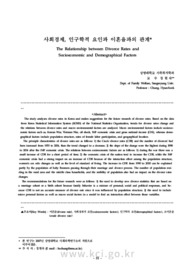
사회경제, 인구학적 요인과 이혼율과의 관계 (The Relationship between Divorce Rates and Socioeconomic and Demographical Factors)

18 페이지
기타파일
최초등록일 2025.03.02 최종저작일 2008.02
18P 미리보기
사회경제, 인구학적 요인과 이혼율과의 관계
  • 미리보기

    서지정보

    · 발행기관 : 가정과삶의질학회
    · 수록지 정보 : 가정과삶의질연구 / 26권 / 1호 / 51 ~ 68페이지
    · 저자명 : 정현숙

    초록

    The study analyzes divorce rates in Korea and makes suggestions for the future research of divorce rates. Based on the data from Korea Statistical Information System (KOSIS) of the National Statistics Organization, trends for divorce rates change and the relations between divorce rates and macro environmental factors are analyzed. Macro environmental factors include socioeconomic factors such as, Korean War, Vietnam War, oil shock, IMF economic crisis and gross national income (GNI), whereas demographical factors include population structure, rates of female labor participation, and geographical location.
    The principle characteristics of divorce rates are as follows: 1) the Crude divorce rates (CDR) and the number of divorced had been increased from 1970 to 2004, then the trend changed to a decrease; 2) the slope of the change were the highest during 1998 to 2004 after the IMF economic crisis. The relations between socioeconomic factors are as follows: 1) during the war there was a small increase of CDR for a short period of time; 2) the economic crisis of the nation tend to increase the CDR, while the IMF economic crisis had a strong impact on an increase of CDR because of the interaction effect among the population structure, women's sex role changes as well as the level of standard of living. The increase in CDR from 1990 to 2000 can be explained partly by the population of baby Boomers passing through their marriage and divorce process. The number of population residing in the rural area and the middle class households, and the mobility of population also had an impact on the divorce rates changes.
    The recommendations for the future research were as follows: 1) the need to develop new divorce statistics that are based on a marriage cohort or a birth cohort because family behavior is a mixture of personal, social and political responses, and because CDR is not an accurate measure of divorce rate since it was influenced by population structure; 2) the need to include micro personal factors as well as macro social factors in a model to find an interaction effect between those variables.

    영어초록

    The study analyzes divorce rates in Korea and makes suggestions for the future research of divorce rates. Based on the data from Korea Statistical Information System (KOSIS) of the National Statistics Organization, trends for divorce rates change and the relations between divorce rates and macro environmental factors are analyzed. Macro environmental factors include socioeconomic factors such as, Korean War, Vietnam War, oil shock, IMF economic crisis and gross national income (GNI), whereas demographical factors include population structure, rates of female labor participation, and geographical location.
    The principle characteristics of divorce rates are as follows: 1) the Crude divorce rates (CDR) and the number of divorced had been increased from 1970 to 2004, then the trend changed to a decrease; 2) the slope of the change were the highest during 1998 to 2004 after the IMF economic crisis. The relations between socioeconomic factors are as follows: 1) during the war there was a small increase of CDR for a short period of time; 2) the economic crisis of the nation tend to increase the CDR, while the IMF economic crisis had a strong impact on an increase of CDR because of the interaction effect among the population structure, women's sex role changes as well as the level of standard of living. The increase in CDR from 1990 to 2000 can be explained partly by the population of baby Boomers passing through their marriage and divorce process. The number of population residing in the rural area and the middle class households, and the mobility of population also had an impact on the divorce rates changes.
    The recommendations for the future research were as follows: 1) the need to develop new divorce statistics that are based on a marriage cohort or a birth cohort because family behavior is a mixture of personal, social and political responses, and because CDR is not an accurate measure of divorce rate since it was influenced by population structure; 2) the need to include micro personal factors as well as macro social factors in a model to find an interaction effect between those variables.

    참고자료

    · 없음
  • 자주묻는질문의 답변을 확인해 주세요

    해피캠퍼스 FAQ 더보기

    꼭 알아주세요

    • 자료의 정보 및 내용의 진실성에 대하여 해피캠퍼스는 보증하지 않으며, 해당 정보 및 게시물 저작권과 기타 법적 책임은 자료 등록자에게 있습니다.
      자료 및 게시물 내용의 불법적 이용, 무단 전재∙배포는 금지되어 있습니다.
      저작권침해, 명예훼손 등 분쟁 요소 발견 시 고객센터의 저작권침해 신고센터를 이용해 주시기 바랍니다.
    • 해피캠퍼스는 구매자와 판매자 모두가 만족하는 서비스가 되도록 노력하고 있으며, 아래의 4가지 자료환불 조건을 꼭 확인해주시기 바랍니다.
      파일오류 중복자료 저작권 없음 설명과 실제 내용 불일치
      파일의 다운로드가 제대로 되지 않거나 파일형식에 맞는 프로그램으로 정상 작동하지 않는 경우 다른 자료와 70% 이상 내용이 일치하는 경우 (중복임을 확인할 수 있는 근거 필요함) 인터넷의 다른 사이트, 연구기관, 학교, 서적 등의 자료를 도용한 경우 자료의 설명과 실제 자료의 내용이 일치하지 않는 경우

“가정과삶의질연구”의 다른 논문도 확인해 보세요!

찾으시던 자료가 아닌가요?

지금 보는 자료와 연관되어 있어요!
왼쪽 화살표
오른쪽 화살표
문서 초안을 생성해주는 EasyAI
안녕하세요 해피캠퍼스의 20년의 운영 노하우를 이용하여 당신만의 초안을 만들어주는 EasyAI 입니다.
저는 아래와 같이 작업을 도와드립니다.
- 주제만 입력하면 AI가 방대한 정보를 재가공하여, 최적의 목차와 내용을 자동으로 만들어 드립니다.
- 장문의 콘텐츠를 쉽고 빠르게 작성해 드립니다.
- 스토어에서 무료 이용권를 계정별로 1회 발급 받을 수 있습니다. 지금 바로 체험해 보세요!
이런 주제들을 입력해 보세요.
- 유아에게 적합한 문학작품의 기준과 특성
- 한국인의 가치관 중에서 정신적 가치관을 이루는 것들을 문화적 문법으로 정리하고, 현대한국사회에서 일어나는 사건과 사고를 비교하여 자신의 의견으로 기술하세요
- 작별인사 독후감
해캠 AI 챗봇과 대화하기
챗봇으로 간편하게 상담해보세요.
2026년 01월 11일 일요일
AI 챗봇
안녕하세요. 해피캠퍼스 AI 챗봇입니다. 무엇이 궁금하신가요?
9:42 오전