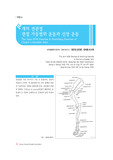
견관절은 개의 전지에서 가장 큰 관절이며, 운동의자유도는 3이다. 즉 견관절에서는 모든 형태의 운동이 가능하다는 의미와 일맥상통 한다. 견관절은 관절의 형태상 구상(ball & socket)관절에 해당되며, 운동성이 큰 반면에 상대적으로 안정성이 낮은 특성이있다.<중략>관절 운동 범위를 유지를 위해서는 많은 강한 노력이필요하다. 신장운동을 적용하면 다음과 같은 효과가있다. 결체조직의 신장 즉 결체 조직을 잡아 늘이면두 가지 반응을 보인다. 1)탄성적 신장의 시기 : 약한힘으로 신장시키면 결체 조직이 어느 정도는 늘어나며 이는 콜라겐 섬유가 직선으로 되기 때문이다. 신장 시켰던 힘을 제거하면 다시 원상 복귀된다. 2)변형기 : 콜라겐 섬유가 직선이 된 후 더 강한 힘을 가하면 비가역적으로 점점 늘어나게 된다. 신장을 가한후 6-8시간 후에 최대로 많이 늘어나며, 신장력을계속 가하는 몇 개월까지도 늘어난다. 결체 조직이비가역적인 길이 이상까지 늘어나면 장력도 줄어들어 낮은 신장력으로도 결체 조직을 계속 늘일 수 있게 된다.<중략>관절의 구축은 관절 낭의 염증성 변화로 인한 신장성에 대한 문제와 부적절한 관절 신장이나 자세로 교원질 섬유의 단축이 야기되며, 관절가동 범위의 모든 방향에서 제한이 되고, 관절인성 구축과 다른 형태의 구축 말기에서 보이는 관절주위 조직의 화학적 변화가 일어난다. 즉, 교원질 대사를 증진시킴으로써 교원질 원섬유 생산이 증진되고 무질서한 교차 연쇄가 형성되며, Proteglycon 함량이 감소되어,관절 강직과 구축이 유발된다.
수치료(Hydrotherapy)란 용어는 그리스의 Hydro(물: Water)와 Therapeia(치유 : Heal ing)란 단어에서유래되었으며, 수치료는 관절염, 정형외과 질환, 근육,인대 및 손상의 많은 종류의 질환에 사용되어지고 있다. 따뜻한 물에 침수(Immersion)하는 것은 넓은 의미에서 수중 운동 치료(Aquatic Exercise Therapy :AET)의 한 범주에 속하며, 통증의 (순환)고리를 끊어지게 하는 효과가 있으므로 손상되어진 부위에서 발생하는 비정상적인 움직임들에 의해 유발되는 관절의 기능부전을 감소시키는 효과 등이 있다. 수중 운동 치료(AET)는 수중 운동과 물리치료의 결합체이며, 이것은포괄적인 치료적 접근법이다.<중략>내·외적인 여러 가지 문제들에 의해 관절의 부동화가 일어나게 되면 결국 관절과 주변 연부 조직에 구축이 일어나게 된다. 구축은 관절, 근육 또는 연부조직의 문제로 인한 완전한 수동 관절 가동범위의 소실로 정의되는데 병리적 변화에 따라 근원성 구축(myogenic contracture), 관 절 인 성 구 축(arthrogenic contracture) 그리고 연부조직성 구축(soft tissue contracture)으로 나누어 볼 수 있다.즉, 운동 결여로서 느슨한 조직이 단축되어 조밀 결합조직이 되고 탄력성, 신전성을 잃게 되며, 이와 같은 과정은 관절 낭, 근 피막, 근 내 결합 조직층, 인대등에 일어난다.<중략>보조기구들은 근·골격계의 기계적 지지를 위해 사용되며, 사지의 능동적인 움직임의 절대적 무능을 개선하기 위해 사용된다. 예를 들면 신경계 재활의 경우 즉 신경이탈 또는 일시적인 무능의 경우 이를 치료하기 위해 지지 장구들이 사용되어지고 있다.
(1) 수 치료따뜻한 물에 침수(immersion)하는 것은 넓은 의미에서 수중 운동 치료(Aquatic exercise therapy)의 한범주에 속하며, 통증의 (순환)고리를 끊어지게 하는효과가 있어 손상되어진 부위에서 발생하는 비정상적인 움직임들에 의해 유발되는 관절의 기능부전을 감소시키는 효과 등이 있다(Andrea et al, 19 96). 뿐만 아니라 수영과 와류욕은 물리치료의 우수한 방법이며, 따뜻한 물은 사지의 혈액순환을 촉진시키고 피부 위에 있는 잔변과 잔뇨의 제거에 도움이 된다(Hoerlein, 1978).<중략>③ 카이로프락틱1980년대 New Jersey에서 카이로프락틱 뿐만 아니라 다른 대체의학의 적용을 장려하기 위한 연합회가 설립되었으며, 그것을 동물을 위한 선택들(Options for Animals)이라고 불렀으며, 이 조직은 나중에 해산되었다.1985년 Georgia주의 Life 대학에서 첫 번째 Annual Animals Chiro practic conference가 열렸다. 호주RMIT대학교의 카이로프락틱학과의 경우 Master of Chiroprac tic Science(Animal Chiropractic)의 학위과정과 Graduate Diploma of Chiropractic Science(Ani mal Chiropractic)의 심화과정이 있다.<중략>2. 결 론위와 같은 내용을 요약하여 다음과 같은 결론을 내려보고자 한다. 동물(수의)물리치료에 대한 명확한 정의는 아직까지 없지만 수의물리치료란 수의학의 진료대상인 환수((患獸) 중 근·골격계, 신경계 그리고 기타질환의 효율적인 치료와 관리를 목적으로 물리치료를수의학적으로 접근하여의료적 서비스의 한 형태로 제공하는 것이라고 정의내리고자 한다.
Motor Neuron DiseaseDefinitionsMotor neuron diseases:Progressive degeneration and loss of motor neurons in the spinal cord with or without similar lesions in the motor nuclei of the brainstem or the motor corte Motor neuron disease = myotrophic lateral sclerosis Spinal muscular atrophy:Only lower motor neuron signs myotrophic lateral sclerosis (LS)= withoutMyo= MuscleTrophic= NourishmentLateral= side of the spinal cordSclerosis= Hardening or scaringLSlso known as Lou Gehrig’s diseaseDegeneration of UMN and LMNccuracy of clinical diagnosis ~ 95%EpidemiologyWorldwide roughly the same prevalence 50 X lO-6
RHS 332: Clinical NeurologyAhmad Alghadir, M.S. Ph.D. P.T. Room: 2071Recommended textsS.B. O'sullivan, T.J. Schmitz, Physical Rehabilitation: Assessment and Treatment, F.A. Davis Company. 3rd ed. 1994. R.L. Braddom, Physical Medicine Rehabilitation, W.B. Saunders Company. 1st ed. 1996.Coordination AssessmentIntroductionCoordination: “ability to execute smooth, accurate, controlled movements.”Coordinated movements are characterized by: “Appropriate speed, distance, direction, rhythm, and muscle tension.” “Appropriate synergist influences.” “Easy reversal between opposing muscle groups.” “Proximal fixation to allow distal motion or maintenance of a posture.”Incoordination (coordination deficit): “abnormal motor function characterized by awkward, extraneous, uneven, or inaccurate movements.” Coordination deficits are often related to, and indicative of, CNS involvement including cerebellum, basal ganglia, and dorsal columns.Examples of diagnoses that typically demonstrate coordination defmotor activity. Equilibrium. Muscle tone. Lesions produce: Incoordination. Impaired balance. Decreased muscle tone.“The cerebellum compares the commands for movement transmitted from the motor cortex with the actual motor performance of the body segment.” “This occurs by a comparison of information received from the cortex with that obtained from peripheral feedback mechanisms.”If movements deviate from the intended command, the cerebellum sends corrective signals to the cortex.Clinical features of cerebellar dysfunction: Hypotonia and hyporeflexia. Dysmetria: “Disturbance in the ability to judge the distance or range of a movement.” Hypometria = underestimation. Hypermetria = overestimation.Dysdiadochokinesia: “Impaired ability to perform rapid alternating movements.” Tremor: “Involuntary oscillatory movement resulting from alternate contractions of opposing muscle groups.” Intention (kinetic) vs. resting (static) tremors.Movement decomposition: “Movement performed in a sequence of coorder of the motor component of speech articulation.” Speech pattern is slow, slurred, hesitant, with prolonged syllables and inappropriate pauses. Word selection and grammar remain intact.Nystagmus. Rebound phenomenon: “Absence of a check reflex; when resistance to an isometric contraction is suddenly removed, the body segment moves forcibly in the direction in which effort was focused.”Asthenia: “Generalized muscle weakness associated with cerebellar lesions.” Difficulty in initiating, stopping, or changing the direction, speed, or force of voluntary movements.Basal gangliaComponents: Putamen. Caudate nucleus. Globus pallidus. Substantia nigra. Subthalamic nucleus.Primary functions: “Initiation and regulation of gross intentional movements.” “Ability to accomplish automatic movements and postural adjustments.” Inhibitory effect on motor cortex and posterior fossa brainstem to maintain normal background muscle tone.”Cognitive and perceptual functions.” Lesions produce: Slowness of movrequired to perform even the simplest motor activity.”Chorea (choreiform movements): “Involuntary, rapid, irregular, jerky movements; clinical feature of Huntington's disease.” Athetosis (athetoid movements): “Slow, involuntary, writhing, twisting, “wormlike” movements; clinical feature of cerebral palsy.”Choreoathetosis: Chorea + athetosis. Hemiballismus: “Sudden, jerky, forceful, wild, flailing, motions of one side of the body.” “Results from a lesion of the contralateral subthalamic nucleus.”Dorsal columnsPrimary function: Mediate proprioceptive input from joint and muscle receptors.Lesions produce: Coordination and balance deficits that are less characteristic than those produced by other CNS lesions due to compensation from visual feedback. Thus, these deficits are exaggerated in dark or with closed eyes.Clinical features of dorsal columns dysfunction: Dysmetria: visual feedback reduces the manifestations of dysmetria. Slowed movements: because visually guided movements are more aproves validity. Apprehension, fear, and fatigue. Lack of reliability. Safety.Classifications of coordination tests: Gross vs. fine motor activities. Non-equilibrium vs. equilibrium tests.Coordination tests focus on assessment of movement in four areas: “Alternate or reciprocal motion, which tests the ability to reverse movement between opposing muscle groups.” “Movement composition, or synergy, which involves movement control achieved by muscle groups acting together.”“Movement accuracy, which assesses the ability to gauge or to judge distance and speed of voluntary movement.” “Fixation or limb holding, which tests the ability to hold the position of an individual limb or limb segment.Recording test resultsArbitrary scale. Timed tests. Videotape recording.Standardized instruments for coordination assessmentJebsen-Taylor Hand Function Test: Measures hand function using seven functional activities: writing; stacking; card turning; simulated feeding; picking up small objects; picking up }