• AI글쓰기 2.1 업데이트
PARTNER
검증된 파트너 제휴사 자료

“사물의 쿠데타” -최인호 단편 「타인의 방」의 사물성 재독 (“Coup ďÉtat of Things” -Reconstructing the Criticism on the Story A Room of Other of Choi In-Ho)

32 페이지
기타파일
최초등록일 2025.05.07 최종저작일 2024.09
32P 미리보기
“사물의 쿠데타” -최인호 단편 「타인의 방」의 사물성 재독
  • 미리보기

    서지정보

    · 발행기관 : 한국현대소설학회
    · 수록지 정보 : 현대소설연구 / 95호 / 301 ~ 332페이지
    · 저자명 : 윤종환

    초록

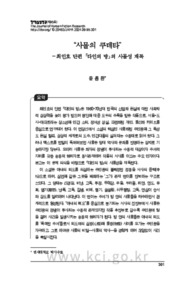
    최인호의 단편 「타인의 방」은 1960-70년대 한국의 산업화 현실에 대한 사회학적 상상력을 높이 평가 받으며 평단과 대중 모두의 주목을 받은 작품으로, 서울-도시-아파트라는 장소성과 인간 소외, 정체성 상실, 파편화된 개인, 물신화 키워드를중심으로 연구되어 왔다. 이 연장선에서 소설의 핵심인 사물화된 주인공과 그 특성도 현실 탈피, 상상적 세계로의 도주, 인간다움의 실패라는 수동태로 읽혀 왔다. 그러나 텍스트를 면밀히 독해해보면 사물은 당대 역사와 문화를 반영하는 장치로 기능하지만 않는다. 오히려 사물은 화자의 정념이 투사되는 수동적 대상이자 주체적지위를 갖춘 능동적 행위자로 동시존재하며 작품의 서사를 이끄는 주요 인자이다.
    본고는 이 문제 의식을 바탕으로 「타인의 방」의 사물성을 재독한다.
    이 소설은 아내의 외도를 의심하는 주인공의 불확정한 정동을 서사의 중핵(中 核)으로 하며, 심연과 같은 그곳을 배회하는 ‘그’가 존재 변이를 반복하는 구조로쓰였다. 그 양태는 신경질, 비난, 고독, 투정, 무력감, 우울, 두려움, 위안, 안도, 유쾌, 염기(厭忌), 난폭, 고독, 집념, 비애, 맹기, 쓸쓸함, 허무맹랑, 고독, 안심이 순서와 강도를 달리하며 나타난다. 이 변이는 주체가 방 안의 사물들을 마주하면서 관계적으로 형성된다. “아내의 메모”를 중심으로 분기되는 서사의 전반부에서 사물은주인공의 정념이 투사되는 수동적 존재였지만 작품 후반부로 갈수록 주인공에 말을 걸며 사건을 발생시키는 능동적 행위자가 된다. 방 안의 사물들은 아내의 외도를 ‘목격한 주체’들로서 외도에의 심증(心證)과 물증(物證) 사이를 오가는 주인공을자극하고, 그로 하여금 사물의 비밀―사물의 역사―을 경험케 하며 끊임없이 사건을 촉발시킨다. 그 사물들은 아내와 ‘나’ 사이의 사랑을 경험했고 또 매개하는 역사적 존재들이기도 하다. 이에 주인공은 아내 외도에의 불안을 해소하고 사랑에 대한 욕망을 실현코자 감시·목격자이자 사랑의 매개 주체인 사물처럼 스스로를 변화시키는 “사물의 쿠데타”에 투항(投降)한다. 사물화된 주인공은 아내를 마주하지만, 아내는 사물로부터 사랑을 느끼고 그것의 역사를 읽는 정동 능력이 약해 ‘그’의 사물되기는 실패로 끝난다. 주인공이 “사물의 쿠데타”에 기대한 효과로서의 낭만적 사랑이 충족되지 못하는 것이다. 이 비극적 결말은 현대인의 사랑과 연인 관계는 물론 사물 스스로가 말하는 삶의 역사에 감응해 자기 존재를 변이시킬 수 있는가의 질문으로확장된다. 따라서 「타인의 방」의 사물성은 도구화된 객체성이나 신자유주의 산업사회의 단면을 껴안으면서도 이에 대한 반성을 촉발시키는 능동성까지 내포한 중층적 작용으로 읽히는 것이다.

    영어초록

    The story The Room of Other, written by Choi-In ho, had highly reputed from critics and the public alike for its sociological imagination to modern Korea had being industrialized in the 1960s and 70s. This story has been studied around the keywords of human alienation, loss of identity, fragmented individuals, and commodity fetishism under placeness of 'apartment', 'city', and 'Seoul'. In this regard, the protagonist who became a thing, a key event in the story, has also been interpreted only within objectification: an escape from reality, running away to imaginary world, or a failure of humanity. However, while reading closely, it is obvious that the things in this text do not function only as symbolic devices that reflect the history and culture of the period when it was written. Rather, things exist simultaneously as passive objects on which the narrator's affect(s) are projected to and as active agents with subject-status, and they are the main factors that drive the plot. With this respect, I strongly point out that the meaning and criticism on the thingness of The Room of Other would be reconstructed.
    The plot of this story is proceeded by focusing on the protagonist's uncertain affect(s) driven by his suspects toward his wife's affair and is structured in such a way that the “he”, roaming around the abyss of affections repeatedly, experiences his existential variations by the affects.These variations are fostered inter-relationally as the subject encounters the things in the room, the place where he and his wife's used to live together. In the first half of the narrative, which bifurcates by the “The Wife's Note,” the things are passive objectives into which the protagonist's affects including strong anxiety are projected, but in the second half, the things appear as active agents who address to him and cause events to occur. The things in the room are the “witnesses” of the wife's affair, stimulating the protagonist to roam between psychological and physical proof of the infidelity, and making him to experience the secret and life history of things, leading the narrative.
    At the same time, the things are historical beings that have experienced and mediated the love between him and his wife. In order to resolve the anxiety from suspecting toward the wife and realize his desire for love, the protagonist surrenders himself to the “coup d'état of things,” transforming himself into a thing that is both a witness and a mediator of love. At the end of the story, although his wife meets objectified protagonist, her wife's ability to affect by the thing, feel love, and read its history is not enough, so the life of him ransformalized to a thing ends up with failure. This tragic ending, in which the protagonist's expectation of romantic love is not fulfilled by the “coup d'état of objects,” provokes the question of authenticity modern love and romantic relationships, as well as if we can transform our existence via being affected by the life histories the things tell. As a result, the thingness of The Room of Other would be understood as characteristic that embraces objectification, an aspect of neoliberal industrial society, but also as an active force that triggers reflection on it keeping the potential to overcome and imagine beyond the reality.

    참고자료

    · 없음
  • 자주묻는질문의 답변을 확인해 주세요

    해피캠퍼스 FAQ 더보기

    꼭 알아주세요

    • 자료의 정보 및 내용의 진실성에 대하여 해피캠퍼스는 보증하지 않으며, 해당 정보 및 게시물 저작권과 기타 법적 책임은 자료 등록자에게 있습니다.
      자료 및 게시물 내용의 불법적 이용, 무단 전재∙배포는 금지되어 있습니다.
      저작권침해, 명예훼손 등 분쟁 요소 발견 시 고객센터의 저작권침해 신고센터를 이용해 주시기 바랍니다.
    • 해피캠퍼스는 구매자와 판매자 모두가 만족하는 서비스가 되도록 노력하고 있으며, 아래의 4가지 자료환불 조건을 꼭 확인해주시기 바랍니다.
      파일오류 중복자료 저작권 없음 설명과 실제 내용 불일치
      파일의 다운로드가 제대로 되지 않거나 파일형식에 맞는 프로그램으로 정상 작동하지 않는 경우 다른 자료와 70% 이상 내용이 일치하는 경우 (중복임을 확인할 수 있는 근거 필요함) 인터넷의 다른 사이트, 연구기관, 학교, 서적 등의 자료를 도용한 경우 자료의 설명과 실제 자료의 내용이 일치하지 않는 경우

“현대소설연구”의 다른 논문도 확인해 보세요!

문서 초안을 생성해주는 EasyAI
안녕하세요 해피캠퍼스의 20년의 운영 노하우를 이용하여 당신만의 초안을 만들어주는 EasyAI 입니다.
저는 아래와 같이 작업을 도와드립니다.
- 주제만 입력하면 AI가 방대한 정보를 재가공하여, 최적의 목차와 내용을 자동으로 만들어 드립니다.
- 장문의 콘텐츠를 쉽고 빠르게 작성해 드립니다.
- 스토어에서 무료 이용권를 계정별로 1회 발급 받을 수 있습니다. 지금 바로 체험해 보세요!
이런 주제들을 입력해 보세요.
- 유아에게 적합한 문학작품의 기준과 특성
- 한국인의 가치관 중에서 정신적 가치관을 이루는 것들을 문화적 문법으로 정리하고, 현대한국사회에서 일어나는 사건과 사고를 비교하여 자신의 의견으로 기술하세요
- 작별인사 독후감
해캠 AI 챗봇과 대화하기
챗봇으로 간편하게 상담해보세요.
2026년 01월 11일 일요일
AI 챗봇
안녕하세요. 해피캠퍼스 AI 챗봇입니다. 무엇이 궁금하신가요?
12:47 오전