• AI글쓰기 2.1 업데이트
PARTNER
검증된 파트너 제휴사 자료

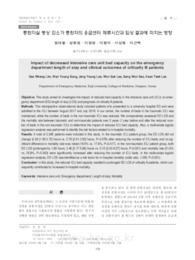
중환자실 병상 감소가 중환자의 응급센터 체류시간과 임상 결과에 미치는 영향 (Impact of decreased intensive care unit bed capacity on the emergency department length of stay and clinical outcomes of critically ill patients)

9 페이지
기타파일
최초등록일 2025.06.01 최종저작일 2021.04
9P 미리보기
중환자실 병상 감소가 중환자의 응급센터 체류시간과 임상 결과에 미치는 영향
  • 미리보기

    서지정보

    · 발행기관 : 대한응급의학회
    · 수록지 정보 : 대한응급의학회지 / 32권 / 2호 / 170 ~ 178페이지
    · 저자명 : 임대황, 성원영, 이장영, 이원석, 서상원, 이근택

    초록

    Objective: This study aimed to investigate the impact of reduced bed capacity in the intensive care unit (ICU) on emergency department (ED) length of stay (LOS) and prognosis of critically ill patients.
    Methods: This retrospective observational study included patients who presented to a university hospital ED and were admitted to the ICU between August 2017 and July 2019. In our center, the number of beds in the traumatic ICU was maintained, while the number of beds in the non-traumatic ICU was reduced. We comparatively assessed ED LOS and the mortality rate between traumatic and non-traumatic patients over 2 years (1 year before and after the reduced number of beds in the non-traumatic ICU) to determine the impact of reduced ICU bed capacity. Also, a multivariate logistic regression analysis was performed to identify the risk factors related to in-hospital mortality.
    Results: A total of 2,945 patients were included in this study. In the traumatic ICU patient group, the ED LOS did not change (2.62 [1.95-3.72] hours vs. 2.78 [2.01-3.92] hours, P=0.079) after reducing the number of ICU beds; and no significant difference in mortality rate was noted (19.5% vs. 17.6%, P=0.417). In the non-traumatic ICU patient group, both ED LOS (prolonged by 1.69 hours, 3.46 [2.17-5.66] hours vs. 5.15 [3.43-8.37] hours, P<0.001) and mortality rate (21.6% vs. 25.8%, P=0.003) were significantly increased after reducing the number of ICU beds. In the multivariate logistic regression analysis, ED LOS was identified as a risk factor for in-hospital mortality (odds ratio, 1.035; P<0.001).
    Conclusion: In this study, the reduced ICU bed capacity resulted in prolonged ED LOS of critically ill patients, which consequently contributed to increased in-hospital mortality.

    영어초록

    Objective: This study aimed to investigate the impact of reduced bed capacity in the intensive care unit (ICU) on emergency department (ED) length of stay (LOS) and prognosis of critically ill patients.
    Methods: This retrospective observational study included patients who presented to a university hospital ED and were admitted to the ICU between August 2017 and July 2019. In our center, the number of beds in the traumatic ICU was maintained, while the number of beds in the non-traumatic ICU was reduced. We comparatively assessed ED LOS and the mortality rate between traumatic and non-traumatic patients over 2 years (1 year before and after the reduced number of beds in the non-traumatic ICU) to determine the impact of reduced ICU bed capacity. Also, a multivariate logistic regression analysis was performed to identify the risk factors related to in-hospital mortality.
    Results: A total of 2,945 patients were included in this study. In the traumatic ICU patient group, the ED LOS did not change (2.62 [1.95-3.72] hours vs. 2.78 [2.01-3.92] hours, P=0.079) after reducing the number of ICU beds; and no significant difference in mortality rate was noted (19.5% vs. 17.6%, P=0.417). In the non-traumatic ICU patient group, both ED LOS (prolonged by 1.69 hours, 3.46 [2.17-5.66] hours vs. 5.15 [3.43-8.37] hours, P<0.001) and mortality rate (21.6% vs. 25.8%, P=0.003) were significantly increased after reducing the number of ICU beds. In the multivariate logistic regression analysis, ED LOS was identified as a risk factor for in-hospital mortality (odds ratio, 1.035; P<0.001).
    Conclusion: In this study, the reduced ICU bed capacity resulted in prolonged ED LOS of critically ill patients, which consequently contributed to increased in-hospital mortality.

    참고자료

    · 없음
  • 자주묻는질문의 답변을 확인해 주세요

    해피캠퍼스 FAQ 더보기

    꼭 알아주세요

    • 자료의 정보 및 내용의 진실성에 대하여 해피캠퍼스는 보증하지 않으며, 해당 정보 및 게시물 저작권과 기타 법적 책임은 자료 등록자에게 있습니다.
      자료 및 게시물 내용의 불법적 이용, 무단 전재∙배포는 금지되어 있습니다.
      저작권침해, 명예훼손 등 분쟁 요소 발견 시 고객센터의 저작권침해 신고센터를 이용해 주시기 바랍니다.
    • 해피캠퍼스는 구매자와 판매자 모두가 만족하는 서비스가 되도록 노력하고 있으며, 아래의 4가지 자료환불 조건을 꼭 확인해주시기 바랍니다.
      파일오류 중복자료 저작권 없음 설명과 실제 내용 불일치
      파일의 다운로드가 제대로 되지 않거나 파일형식에 맞는 프로그램으로 정상 작동하지 않는 경우 다른 자료와 70% 이상 내용이 일치하는 경우 (중복임을 확인할 수 있는 근거 필요함) 인터넷의 다른 사이트, 연구기관, 학교, 서적 등의 자료를 도용한 경우 자료의 설명과 실제 자료의 내용이 일치하지 않는 경우
문서 초안을 생성해주는 EasyAI
안녕하세요 해피캠퍼스의 20년의 운영 노하우를 이용하여 당신만의 초안을 만들어주는 EasyAI 입니다.
저는 아래와 같이 작업을 도와드립니다.
- 주제만 입력하면 AI가 방대한 정보를 재가공하여, 최적의 목차와 내용을 자동으로 만들어 드립니다.
- 장문의 콘텐츠를 쉽고 빠르게 작성해 드립니다.
- 스토어에서 무료 이용권를 계정별로 1회 발급 받을 수 있습니다. 지금 바로 체험해 보세요!
이런 주제들을 입력해 보세요.
- 유아에게 적합한 문학작품의 기준과 특성
- 한국인의 가치관 중에서 정신적 가치관을 이루는 것들을 문화적 문법으로 정리하고, 현대한국사회에서 일어나는 사건과 사고를 비교하여 자신의 의견으로 기술하세요
- 작별인사 독후감
  • 전문가 요청 쿠폰 이벤트
  • 전문가요청 배너
해캠 AI 챗봇과 대화하기
챗봇으로 간편하게 상담해보세요.
2025년 12월 07일 일요일
AI 챗봇
안녕하세요. 해피캠퍼스 AI 챗봇입니다. 무엇이 궁금하신가요?
3:14 오전