• AI글쓰기 2.1 업데이트
PARTNER
검증된 파트너 제휴사 자료

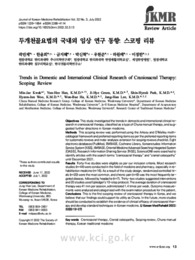
두개천골요법의 국내외 임상 연구 동향: 스코핑 리뷰 (Trends in Domestic and International Clinical Research of Craniosacral Therapy: Scoping Review)

15 페이지
기타파일
최초등록일 2025.03.14 최종저작일 2022.07
15P 미리보기
두개천골요법의 국내외 임상 연구 동향: 스코핑 리뷰
  • 미리보기

    서지정보

    · 발행기관 : 한방재활의학과학회
    · 수록지 정보 : 한방재활의학과학회지 / 32권 / 3호 / 13 ~ 27페이지
    · 저자명 : 곽민제, 한윤희, 금지혜, 박신혁, 우현준, 하원배, 이정한

    초록

    Objectives This study investigated the trends in domestic and international clinical research in craniosacral therapy, classified as a type of Chuna manual therapy, and suggested further directions in Korean medicine.
    Methods This scoping review was performed using the Arksey and O’Malley methodological framework and preferred reporting items as per the preferred reporting items for systematic reviews and meta-analyses extension for scoping reviews checklist. Eight electronic databases (PubMed, EMBASE, Cochrane Library, Koreanstudies Information Service System [KISS], KMBASE, Oriental Medicine Advanced Searching Integrated System [OASIS], Research Information Sharing Service [RISS], ScienceON) were searched to identify articles with the search terms “craniosacral therapy” and “cranial osteopathy” until December 2021.
    Results Forty-five studies were eligible as per our inclusion criteria. Most research studies (n=44) were conducted in the field of medicine and pharmacy, especially in rehabilitation medicine (n=16). As a result of the study design, randomized controlled trials (n=20) were the most common, and chronic pain (n=9) was the most frequently targeted disease, followed by headache (n=7). Thirty-two studies suggested interventions and 20 studies used Upledger's 10-step protocol. The average duration of craniosacral therapy was 41 min per session, administered 1.4 times per week. Outcome measurements were analyzed and categorized with the examination procedure for the patient.
    Conclusions This is the first scoping review of craniosacral therapy in Korea, and we believe that our findings could support its utility as Chuna. In the future, more studies should be conducted to establish the evidence of clinical efficacy of craniosacral therapy and develop standard techniques in Korean medicine.

    영어초록

    Objectives This study investigated the trends in domestic and international clinical research in craniosacral therapy, classified as a type of Chuna manual therapy, and suggested further directions in Korean medicine.
    Methods This scoping review was performed using the Arksey and O’Malley methodological framework and preferred reporting items as per the preferred reporting items for systematic reviews and meta-analyses extension for scoping reviews checklist. Eight electronic databases (PubMed, EMBASE, Cochrane Library, Koreanstudies Information Service System [KISS], KMBASE, Oriental Medicine Advanced Searching Integrated System [OASIS], Research Information Sharing Service [RISS], ScienceON) were searched to identify articles with the search terms “craniosacral therapy” and “cranial osteopathy” until December 2021.
    Results Forty-five studies were eligible as per our inclusion criteria. Most research studies (n=44) were conducted in the field of medicine and pharmacy, especially in rehabilitation medicine (n=16). As a result of the study design, randomized controlled trials (n=20) were the most common, and chronic pain (n=9) was the most frequently targeted disease, followed by headache (n=7). Thirty-two studies suggested interventions and 20 studies used Upledger's 10-step protocol. The average duration of craniosacral therapy was 41 min per session, administered 1.4 times per week. Outcome measurements were analyzed and categorized with the examination procedure for the patient.
    Conclusions This is the first scoping review of craniosacral therapy in Korea, and we believe that our findings could support its utility as Chuna. In the future, more studies should be conducted to establish the evidence of clinical efficacy of craniosacral therapy and develop standard techniques in Korean medicine.

    참고자료

    · 없음
  • 자주묻는질문의 답변을 확인해 주세요

    해피캠퍼스 FAQ 더보기

    꼭 알아주세요

    • 자료의 정보 및 내용의 진실성에 대하여 해피캠퍼스는 보증하지 않으며, 해당 정보 및 게시물 저작권과 기타 법적 책임은 자료 등록자에게 있습니다.
      자료 및 게시물 내용의 불법적 이용, 무단 전재∙배포는 금지되어 있습니다.
      저작권침해, 명예훼손 등 분쟁 요소 발견 시 고객센터의 저작권침해 신고센터를 이용해 주시기 바랍니다.
    • 해피캠퍼스는 구매자와 판매자 모두가 만족하는 서비스가 되도록 노력하고 있으며, 아래의 4가지 자료환불 조건을 꼭 확인해주시기 바랍니다.
      파일오류 중복자료 저작권 없음 설명과 실제 내용 불일치
      파일의 다운로드가 제대로 되지 않거나 파일형식에 맞는 프로그램으로 정상 작동하지 않는 경우 다른 자료와 70% 이상 내용이 일치하는 경우 (중복임을 확인할 수 있는 근거 필요함) 인터넷의 다른 사이트, 연구기관, 학교, 서적 등의 자료를 도용한 경우 자료의 설명과 실제 자료의 내용이 일치하지 않는 경우

“한방재활의학과학회지”의 다른 논문도 확인해 보세요!

문서 초안을 생성해주는 EasyAI
안녕하세요 해피캠퍼스의 20년의 운영 노하우를 이용하여 당신만의 초안을 만들어주는 EasyAI 입니다.
저는 아래와 같이 작업을 도와드립니다.
- 주제만 입력하면 AI가 방대한 정보를 재가공하여, 최적의 목차와 내용을 자동으로 만들어 드립니다.
- 장문의 콘텐츠를 쉽고 빠르게 작성해 드립니다.
- 스토어에서 무료 이용권를 계정별로 1회 발급 받을 수 있습니다. 지금 바로 체험해 보세요!
이런 주제들을 입력해 보세요.
- 유아에게 적합한 문학작품의 기준과 특성
- 한국인의 가치관 중에서 정신적 가치관을 이루는 것들을 문화적 문법으로 정리하고, 현대한국사회에서 일어나는 사건과 사고를 비교하여 자신의 의견으로 기술하세요
- 작별인사 독후감
해캠 AI 챗봇과 대화하기
챗봇으로 간편하게 상담해보세요.
2026년 01월 26일 월요일
AI 챗봇
안녕하세요. 해피캠퍼스 AI 챗봇입니다. 무엇이 궁금하신가요?
12:56 오전