• AI글쓰기 2.1 업데이트
PARTNER
검증된 파트너 제휴사 자료

영화 <서편제>에 투영된 판소리의 모습과 ‘우리 것’의 의미 - 각색자 김명곤과 1990년대 초반 문화 현실을 기반으로 - (Reality and Ideal, and Meaning as Korean Traditional Thing in Movie Sopyeonje)

55 페이지
기타파일
최초등록일 2025.03.10 최종저작일 2014.10
55P 미리보기
영화 &lt;서편제&gt;에 투영된 판소리의 모습과 ‘우리 것’의 의미 - 각색자 김명곤과 1990년대 초반 문화 현실을 기반으로 -
  • 미리보기

    서지정보

    · 발행기관 : 우리문학회
    · 수록지 정보 : 우리문학연구 / 44호 / 145 ~ 199페이지
    · 저자명 : 송소라

    초록

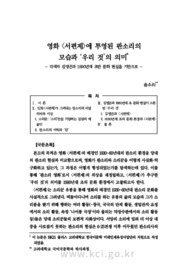
    본고의 목적은 영화 <서편제>의 배경인 1930~60년대의 판소리 환경을 당대의 판소리 현실과 비교함으로써, 영화가 판소리와 소리꾼을 어떻게 사실화·허구화하고 있는가, 그 과정은 어떻게 형성되었는가를 탐색하는데 있다. 이를 통해 ‘판소리 영화’로서 <서편제>의 위상을 재정립하고, <서편제>가 추구한 ‘우리 것’의 의미를 1990년대 초의 문화 환경에서 고찰하고자 한다.
    <서편제>는 소리꾼 유봉을 통해 영화의 배경인 1930~60년대 판소리 문화를 사실적으로 그려낸다. 떠돌아다니며 소리를 하는 유봉의 삶의 모습과 그가 소리품을 팔기 위해 행하는 여러 활동(-창극, 국극의 단체 활동, 생일잔치·요정에서의 소리 활동, 속칭 ‘나이롱 극장’이라 불리는 약장수판에서의 소리 활동 등)들은 당대 소리꾼들의 보편적 자화상이다. 서양의 소리에 밀려 더 이상 대중을 사로잡지 못하는 판소리의 현실은 6·25전쟁 이후 어두웠던 판소리사의 단면을 사실적으로 보여주며, 유봉의 대사와 영화의 장면을 통해 강조하는 북과 소리의 조화, 판소리의 이면, 한과 신명의 공존은 판소리에서 중요하게 다뤄지는 미적 요소들이다. 송화와 유봉의 소리 학습 과정, 가난에 시달리는 소리꾼들의 인생 역경은 허구적으로 만들어진 영화의 현실이 아니다. 당대 소리꾼이라면 누구나 겪었음직한 실제이다.
    그럼에도 영화 <서편제>는 소리꾼과 판소리의 미학을 지나치게 이상화한다. 영화를 통해 탄생한 인물 유봉은 현실과 자본에 휘둘리지 않으면서 오로지 소리만을 추구하는 예술인으로 그려진다. 판소리는 그와 같은 예술인이 추구하는 세계이자, 판소리를 통한 ‘득음’은 그 무엇을 희생하여서라도 얻어야 할 궁극의 가치로 표현이 된다. 유봉과 송화, 동호 모두는 ‘한(恨)’을 중심으로 서로를 이해하고, 그 한을 넘어서는 것은 오로지 예술로서의 소리이다. 득음의 최종 경지로 한을 쌓기 위해 송화의 눈을 멀게 한 유봉의 행위, 한을 지키기 위해 서로를 그리워했음에도 끝내 말없이 헤어지는 송화와 동호의 서사는 예술로서 판소리를 지나지게 신성화한다.
    <서편제>의 리얼리티와 이상은 각색자 김명곤과 1964년 이후의 판소리의 문화 현실을 통해 획득이 된다. 김명곤은 그 스스로가 10년간 소리를 배운 전문 소리꾼이자, 배우이며 시나리오 작가·연출가이다. 또한 수많은 명인명창을 만나며 『광대열전』(1988)이라는 책을 펴낸 작가이기도 하다. 그가 창조해 낸 유봉은 그 자신은 물론 그가 만난 명창들의 집합체라 해도 과언이 아니다. <서편제>의 리얼리티의 획득은 전문 소리꾼인 그에 의해, 그리고 영화의 제작과정에서 김명곤을 가장 존중한 임권택의 의지에 의해 상당부분 이루어진다. 한편, <서편제>의 이상화는 소설의 결말을 수용하는 과정에서, 나아가 판소리가 1964년 무형문화재가 되면서 스스로를 예술로 규정하는 과정에서 이루어졌다. 판소리는 문화재가 되면서 아이러니하게도 ‘사라지지 않도록 지키고 알려야 하는 전통’이면서 동시에 ‘함부로 훼손해서는 안 되는 고유한 예술’이 되었다. 문화재가 된 명창들은 자신들의 어두웠던 시절을 생각하며 ‘소리’에만 집중하는 소리꾼을 이상적이라 생각하였고, 가벼이 대중문화와 어울리는 판소리를 원하지 않았다. 소리꾼으로서 자신의 경험은 물론 여러 명창들의 삶의 모습을 충실히 담아내고 싶었던 김명곤은 이청준이 추구한 ‘한을 넘어서는 소리’를 ‘절대미학을 추구하는 예술, 판소리’의 이름으로 소환하였다.
    흥미롭게도 1990년대 초의 문화 환경은 ‘예술’로서 판소리에 그 어느 때보다 폭발적으로 환호하였다. 세계화 시대의 흐름 속에서 ‘우리 것’은 국가의 자존심은 물론 국민 스스로 자신의 정체성을 확립하기 위해 긴밀히 필요한 구호였다. 그러나 1990년대 초 ‘우리 것’은 보다 가치론적이고 도덕적인 의미를 띠었다. 그것은 소비 위주의 사회가 심화됨에 따라 점차 물질과 자본에 충실해지는 시류의 반대 항으로, 퇴폐와 향락 중심적이며 일회성만을 강조하는 신세대, 오렌지 문화의 해악 속에서 그 해결책으로 의미를 가졌던 것이다.
    <서편제>가 신드롬을 일으킨 1990년대 초 ‘전통’은 단순히 ‘우리의 것’만을 의미하지 않았다. 그 속에는 보다 순결하고, 소박하고, 영구적이며, 도덕적인 의미가 내포되어 있었다. 고집스러울 만큼 완성된 예술세계만을 추구하는 유봉, 돈과 명창의 이름이 아닌 ‘소리’가 좋아 이것만을 따르는 송화, 가난이 싫어 아버지와 누이를 버렸지만 이들을 잊지 못하고 끝내 그 행적을 쫓는 동호, 그리고 이 모든 인물들의 한과 슬픔을 넘어서는 예술로서 판소리는 가치론적 측면에서 ‘우리 것’의 의미를 보다 명확하게 실현해주었다.
    본고는 그동안의 <서편제> 연구에서 놓친 영화의 텍스트 분석을 각색자와의 관계를 통해 보다 치밀히 진행함으로써 이 작품이 판소리사의 여러 측면을 사실적으로 재현하고 있다는 것, 판소리의 미학을 다각적으로 보여주고 있다는 것을 밝히고자 하였다. 이로써 <서편제> 연구에서 중심이 되었던 ‘한’의 문제를 새로운 시각에서 조망하고자 하였다. 아울러 영화가 상영되었던 당시의 사회상과 문화 환경 속에서 <서편제>가 관객과 어떻게 조우하고 있는가를 분석하여 <서편제> 흥행의 새로운 일면을 제시하고, 영화가 신드롬을 일으킨 당대 현실 속에서 ‘우리 것’의 의미를 보다 구체적으로 살피고자 하였다.

    영어초록

    The purpose of this study is to investigate how a movie actualizes and fictionalizes pansori and how the process is formed by comparing the pansori environment of 1930~60’s as the background of Sopyeonje and the environment at the time. It thereby attempts to redefine the phase of Sopyonje as a pansori movie and to review the meaning of a ‘Korean thing’ that Sopyonje has pursued in the cultural environment of the early of the 1990’s.
    Sopyonje realistically describes the pansori culture of 1930~60’s as the background of the movie through pansori singer Yoobong. The universal self-portrait of the contemporary pansori singers includes not only the life of Yoobong wandering from place to place but also various activities [(Changgeuk, group activities of Gukgeuk, singing activities at the birthday party and the restaurant, singing activities at the then peddler’s medicine-selling site commonly called “nylon theater (temporary theater)” that pansori singers do to bring in income. The reality of the pansori pushed out by western sounds, which did not enthrall the public realistically, shows the aspect of the gloomy pansori history after Korean War. The harmony between the pansori and the drum, emphasized through Yoobong’s lines and movie scenes, and the background of pansaori are the aesthetic factors that are covered critically. Songhwa’s and Yoobong’s pansori learning processes and the poverty-stricken pansori singers’ life adversity do not reflect the reality of the movie made fictionally. They are the actual situation that every contemporary pansori singer may have experienced. Nevertheless, the movie Sopyonje excessively idealizes the aesthetics of pansori singers and pansori itself. Yoobong, newly born through the movie Sopyonje, is described as an artist pursuing only the pansori, not being swayed by reality and capital. Pansori is the world that such an artist as him pursues, and ‘teuk-eum’ through pansori is expressed as an ultimate value that one should obtain no matter how he/she sacrifices. It is only through the pansori as an art that Yoobong, Songhwa, and Dongho all understand each other centering around ‘han’ and that they overcome it. Yoobong’s behavior to blind Songhwa to cultivate her ‘han’ as the final stage for teuk-eum’ and the narrative between Songhwa and Donghwa finally breaking up without any words even though they missed each other to keep ‘han’ extremely consecrate pansori as an art.
    The reality and idea of Sopyonje are obtained through playwrighter Kim Myung-gon and the cultural reality of pansori since 1970’s. Kim, Myung-gon is a professional pansori singer, who has himself learned the pansori for 10 years, and a scenario writer and a director. He is also a writer who has published Gandaeyeoljeon(1988) in his effort after meeting a number of pansori masters and well-known pansori singers. Yoobong that he created in the movie is an aggregator of the well-known pansori singers that he met and himself. Much of reality of Sopyonje has been obtained by him as a professional pansori singer. Meanwhile, the idealization of Sopyonje has been done in the process of accepting the end of the novel and defining it as an art as pansori became an intangible cultural heritage in 1964. Pansori ironically became the tradition to be kept and informed to be prevent from disappearing and at the same time an unique art that should not be damaged carelessly. Well-known pansori singers designated as a cultural heritage though their dark days and regarded a pansori singer focuses on the pansori’ alone as ideal and did not want the pansori to lightly get along with ‘pansori sound.’ Kim Myung-gon, who wanted to faithfully express his experience as a pansori singer and the look of various pansori singers’ life, summoned the sound that goes beyond ‘han’ pursued by Lee Cheong-joon into 'pansori, an art pursuing absolute aesthetics.
    Interestingly, the cultural environment in the early of 1990’s was more explosively cheered on pansori as an art. A Korean traditional thing in the era of globalization became a national pride to people and an urgently-needed slogan for them to establish their identity. However, a ‘Korea traditional thing’ in the early 1990’s had a more axiological and moral meaning. It also meant a solution under an influence of the new generation-orange culture, which is decadent and pleasure-oriented and puts an emphasis on one- time events only in the opposite direction of the current of the times when one gradually becomes to be faithful to materials and capital, as the consumption-oriented society is deepened.
    ‘Tradition’ did not simply mean a ‘Korean traditional thing’ alone. It had internally a more pure, simple, permanent, and moral implication. Pansori realized the meaning of a ‘Korean traditional thing’ more clearly in terms of values as an art beyond the ‘han’ and sorrow of all the characters, including Yoobong who pursues the finished art world only, Songhwa who follows pansori, not money and a fame as a well-known pansori singer, and Dongho who does not forget his father and elder sister and runs after their trace even after leaving because of the poverty he suffered. Pansori as a vanishing art world was a sacred tradition to keep.

    참고자료

    · 없음
  • 자주묻는질문의 답변을 확인해 주세요

    해피캠퍼스 FAQ 더보기

    꼭 알아주세요

    • 자료의 정보 및 내용의 진실성에 대하여 해피캠퍼스는 보증하지 않으며, 해당 정보 및 게시물 저작권과 기타 법적 책임은 자료 등록자에게 있습니다.
      자료 및 게시물 내용의 불법적 이용, 무단 전재∙배포는 금지되어 있습니다.
      저작권침해, 명예훼손 등 분쟁 요소 발견 시 고객센터의 저작권침해 신고센터를 이용해 주시기 바랍니다.
    • 해피캠퍼스는 구매자와 판매자 모두가 만족하는 서비스가 되도록 노력하고 있으며, 아래의 4가지 자료환불 조건을 꼭 확인해주시기 바랍니다.
      파일오류 중복자료 저작권 없음 설명과 실제 내용 불일치
      파일의 다운로드가 제대로 되지 않거나 파일형식에 맞는 프로그램으로 정상 작동하지 않는 경우 다른 자료와 70% 이상 내용이 일치하는 경우 (중복임을 확인할 수 있는 근거 필요함) 인터넷의 다른 사이트, 연구기관, 학교, 서적 등의 자료를 도용한 경우 자료의 설명과 실제 자료의 내용이 일치하지 않는 경우

“우리문학연구”의 다른 논문도 확인해 보세요!

문서 초안을 생성해주는 EasyAI
안녕하세요 해피캠퍼스의 20년의 운영 노하우를 이용하여 당신만의 초안을 만들어주는 EasyAI 입니다.
저는 아래와 같이 작업을 도와드립니다.
- 주제만 입력하면 AI가 방대한 정보를 재가공하여, 최적의 목차와 내용을 자동으로 만들어 드립니다.
- 장문의 콘텐츠를 쉽고 빠르게 작성해 드립니다.
- 스토어에서 무료 이용권를 계정별로 1회 발급 받을 수 있습니다. 지금 바로 체험해 보세요!
이런 주제들을 입력해 보세요.
- 유아에게 적합한 문학작품의 기준과 특성
- 한국인의 가치관 중에서 정신적 가치관을 이루는 것들을 문화적 문법으로 정리하고, 현대한국사회에서 일어나는 사건과 사고를 비교하여 자신의 의견으로 기술하세요
- 작별인사 독후감
  • 전문가 요청 쿠폰 이벤트
  • 전문가요청 배너
해캠 AI 챗봇과 대화하기
챗봇으로 간편하게 상담해보세요.
2025년 12월 05일 금요일
AI 챗봇
안녕하세요. 해피캠퍼스 AI 챗봇입니다. 무엇이 궁금하신가요?
1:13 오전