-
1. Ricardian model
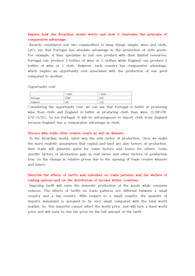
The Ricardian model is a fundamental concept in international trade theory that explains the gains from trade based on comparative advantage. It demonstrates how countries can benefit from specializing in the production of goods in which they have a comparative advantage and trading with other countries. The model highlights the importance of relative productivity differences between countries as the driver of trade patterns. While the Ricardian model provides a useful framework for understanding the basic mechanisms of trade, it also has some limitations, such as its assumption of constant returns to scale and the lack of consideration for factors like transportation costs, economies of scale, and imperfect competition. Nevertheless, the Ricardian model remains a valuable tool for analyzing the gains from trade and the patterns of international specialization.
-
2. Trade winners and losers
The concept of trade winners and losers is a complex and often contentious issue in international trade. On one hand, trade can lead to overall economic gains through increased efficiency, access to a wider range of goods and services, and lower prices for consumers. However, trade can also create winners and losers within a country, as some industries and workers may benefit from trade while others may face job losses or wage stagnation. The distributional impacts of trade are often uneven, with some segments of the population experiencing significant disruption and adjustment costs. Addressing these distributional concerns is a key challenge for policymakers, who must balance the aggregate gains from trade with the need to support and compensate those who are adversely affected. Effective policies, such as job retraining programs, social safety nets, and adjustment assistance, can help mitigate the negative impacts of trade and ensure that the benefits are more broadly shared.
-
3. Tariffs and subsidies
Tariffs and subsidies are two of the most commonly used trade policy instruments, but their impacts on the economy can be complex and multifaceted. Tariffs, which are taxes on imported goods, can protect domestic industries from foreign competition, but they can also lead to higher prices for consumers and potential retaliation from trading partners. Subsidies, on the other hand, can support domestic industries and promote the development of strategic sectors, but they can also distort market signals and lead to inefficient resource allocation. The use of tariffs and subsidies often involves a delicate balance between promoting domestic economic interests and maintaining a rules-based international trading system. Policymakers must carefully consider the potential costs and benefits of these trade policy tools, as well as their broader implications for economic growth, competitiveness, and international relations. Ultimately, the effective use of tariffs and subsidies requires a nuanced understanding of the complex dynamics of international trade and a commitment to policies that balance the interests of various stakeholders.
-
4. Intertemporal comparative advantage
The concept of intertemporal comparative advantage is an important extension of the Ricardian model of trade, which focuses on the gains from trade based on differences in relative productivity between countries. Intertemporal comparative advantage recognizes that a country's comparative advantage can change over time, as its production capabilities and factor endowments evolve. This dynamic perspective on trade patterns suggests that countries may need to adjust their specialization and trade strategies as their comparative advantages shift. For example, a country may initially have a comparative advantage in labor-intensive manufacturing, but as it develops and accumulates capital, its comparative advantage may shift towards more capital-intensive industries. Understanding intertemporal comparative advantage can help policymakers design trade policies that are more responsive to these dynamic changes, allowing countries to capitalize on their evolving strengths and adapt to the shifting global economic landscape. However, the implementation of such policies can be challenging, as it requires a deep understanding of a country's economic trajectory and the complex interplay of factors that shape its comparative advantages over time.
-
5. Export subsidies and agricultural subsidies
Export subsidies and agricultural subsidies are two types of trade policies that have been widely used by governments to support domestic industries and producers. Export subsidies, which provide financial assistance to domestic firms to help them sell their products abroad, can be effective in boosting a country's exports and improving its trade balance. However, they can also distort global trade patterns, lead to retaliatory actions from trading partners, and potentially harm the welfare of consumers in the subsidizing country. Agricultural subsidies, on the other hand, are often used to support farmers and ensure food security, but they can also create market distortions, lead to overproduction, and negatively impact the competitiveness of agricultural producers in other countries. The use of these subsidies has been a contentious issue in international trade negotiations, with many countries pushing for their reduction or elimination to promote a more level playing field. Ultimately, the effectiveness and appropriateness of export subsidies and agricultural subsidies depend on the specific economic and political context, and policymakers must carefully weigh the potential benefits and costs to ensure that these policies align with broader economic and social objectives.
-
6. Import Substitution Industrialization (ISI)
Import Substitution Industrialization (ISI) is a development strategy that aims to promote domestic industrial production and reduce a country's reliance on imports. The key idea behind ISI is to protect and nurture domestic industries through various policy tools, such as tariffs, quotas, and subsidies, in order to enable them to become more competitive and eventually replace imported goods with domestically produced alternatives. While ISI has been implemented by many developing countries in the past, its effectiveness and long-term impacts have been widely debated. On the one hand, ISI can help foster the growth of domestic industries, create jobs, and reduce a country's vulnerability to external shocks. However, it can also lead to inefficiencies, higher consumer prices, and a lack of exposure to international competition, which can ultimately undermine a country's long-term competitiveness. Additionally, the implementation of ISI policies often requires significant government intervention and resources, which can be challenging for developing countries with limited fiscal and institutional capacities. Overall, the success of ISI strategies depends on a range of factors, including the specific economic and political context, the design and implementation of the policies, and the ability of domestic industries to eventually become globally competitive.
-
7. WTO dispute settlement
The World Trade Organization's (WTO) dispute settlement system is a critical mechanism for resolving trade-related conflicts between member countries. This system provides a rules-based framework for addressing disputes, with the goal of promoting a stable and predictable international trading environment. The WTO dispute settlement process involves a series of steps, including consultations, panel hearings, and potential appeals, which aim to ensure that trade disputes are resolved in a fair and transparent manner. The system has been generally effective in addressing a wide range of trade-related issues, from tariffs and subsidies to intellectual property rights and technical barriers to trade. However, the dispute settlement system has also faced some challenges, such as the recent impasse in the appointment of new Appellate Body members, which has raised concerns about the system's long-term viability. Nonetheless, the WTO dispute settlement mechanism remains an important tool for maintaining the integrity of the multilateral trading system and ensuring that countries adhere to their commitments under WTO agreements. Strengthening and improving the dispute settlement system will be crucial for addressing emerging trade-related challenges and promoting a more equitable and sustainable global economy.
-
8. Fair trade
The concept of fair trade is a social movement that aims to promote more equitable and sustainable trading practices, particularly for producers in developing countries. The key principles of fair trade include ensuring fair prices and wages for producers, promoting environmentally sustainable production methods, and providing support for community development initiatives. Fair trade has gained significant traction in recent years, with a growing number of consumers and businesses seeking to source products from fair trade-certified producers. While the impact of fair trade on global trade patterns and the well-being of producers is still debated, there is evidence that it can provide tangible benefits, such as improved incomes, better working conditions, and greater environmental stewardship. However, the implementation and certification of fair trade practices can be complex, and there are concerns about the potential for greenwashing and the exclusion of smaller producers. Ultimately, the success of fair trade will depend on the ability of the movement to balance the interests of producers, consumers, and other stakeholders, while also addressing the broader structural inequities and power imbalances that exist in the global trading system.
-
9. FDI short-term and long-term impacts
Foreign Direct Investment (FDI) can have significant short-term and long-term impacts on the host country's economy. In the short term, FDI can provide a boost to economic growth, create new jobs, and introduce new technologies and managerial practices. FDI can also lead to increased exports and improved trade balances, as multinational corporations leverage their global supply chains and distribution networks. However, the long-term impacts of FDI are more complex and can depend on a variety of factors, such as the type of investment, the industry, the level of technology transfer, and the host country's policies and institutions. In the long run, FDI can contribute to the development of domestic industries, foster innovation and productivity growth, and facilitate the integration of the host country into global value chains. At the same time, FDI can also lead to the displacement of domestic firms, the concentration of economic power, and the potential for negative environmental and social impacts. Policymakers must carefully balance the potential benefits and risks of FDI, and implement policies that maximize the positive long-term impacts while mitigating the negative consequences. This may involve measures such as targeted investment promotion, technology transfer requirements, and robust regulatory frameworks to ensure that FDI aligns with the host country's broader development objectives.
-
10. FTA and Stolper-Samuelson theorem
The Stolper-Samuelson theorem is a fundamental concept in international trade theory that explains the distributional impacts of trade liberalization, such as through the establishment of Free Trade Agreements (FTAs). The theorem suggests that trade liberalization will lead to an increase in the real returns of the abundant factor of production (e.g., labor or capital) and a decrease in the real returns of the scarce factor. In other words, trade can benefit the owners of the abundant factor (e.g., workers in labor-abundant countries) while harming the owners of the scarce factor (e.g., workers in capital-abundant countries). This uneven distribution of the gains from trade is a key challenge in the implementation of FTAs, as it can create political and social tensions within and between countries. Policymakers must carefully consider the Stolper-Samuelson effects and implement complementary policies, such as adjustment assistance, retraining programs, and social safety nets, to ensure that the benefits of trade liberalization are more broadly shared. Additionally, the Stolper-Samuelson theorem may need to be revisited in light of more complex trade patterns, such as those involving global value chains and the trade in tasks, which can lead to more nuanced distributional impacts. Ultimately, the successful implementation of FTAs requires a comprehensive understanding of the potential winners and losers and a commitment to policies that promote inclusive economic growth.
-
11. NAFTA costs and benefits for the US
The North American Free Trade Agreement (NAFTA) has been a subject of significant debate and controversy, particularly regarding its costs and benefits for the United States. On the one hand, NAFTA has been credited with increasing trade and investment flows between the US, Canada, and Mexico, leading to lower consumer prices, greater product variety, and the creation of new jobs in export-oriented industries. NAFTA has also facilitated the integration of North American supply chains, enhancing the competitiveness of US firms in global markets. However, the agreement has also been criticized for contributing to the loss of manufacturing jobs in the US, particularly in industries that faced increased competition from lower-cost Mexican producers. The distributional impacts of NAFTA have been uneven, with some regions and communities experiencing significant economic disruption and dislocation. Policymakers have grappled with the challenge of balancing the aggregate economic gains from trade with the need to support and compensate those who have been adversely affected. The renegotiation of NAFTA into the United States-Mexico-Canada Agreement (USMCA) in 2018 was an attempt to address some of these concerns, but the long-term impacts of the new agreement remain to be seen. Ultimately, the assessment of NAFTA's costs and benefits for the US requires a nuanced understanding of the complex economic, social, and political dynamics at play, as well as a commitment to policies that promote inclusive and sustainable economic growth.


 이 자료를 선택해야 하는 이유


 어도비 PDF